lesson 22: Access cavity preparation
Lesson 22: Access Cavity Preparation
What is Access Cavity Prep?
Definition: Access cavity preparation is the process of creating an opening in the crown of a tooth to reach the pulp chamber and root canals.
Why is it Important?
- Effective Access to Pulp Chamber: The primary function is to provide clear access. Without this, RCT is difficult.
- Canal Identification: Ensures all canal orifices are found, reducing the risk of missed canals and treatment failure.
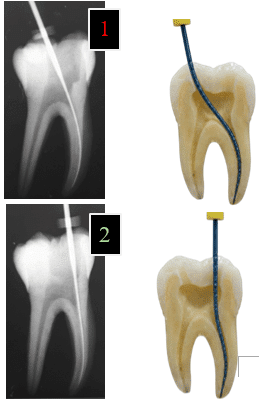
- Facilitates Cleaning & Shaping: Enables “Straight Line Access” (SLA), minimizing procedural errors like ledges.
- Preventing Procedural Errors: Reduces risk of perforations or iatrogenic errors.
Principle 1: Straight-Line Access
The access cavity should allow instruments to enter the root canal system in a direct, straight line, minimizing unnecessary angles or curves.
Importance
- Enables files and rotary systems to follow the natural path of the canal effectively.
- Reduces the risk of creating ledges, transportation, or perforations during instrumentation.
Clinical Application Tips
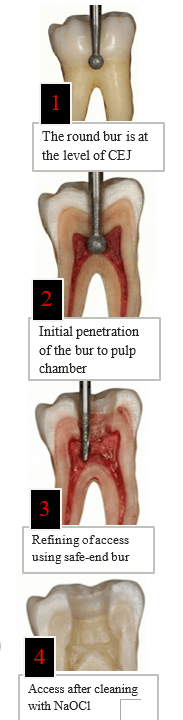
Method: Begin with a conservative, small opening and enlarge gradually.
Why: Avoids excessive removal of tooth structure which compromises strength.
Tool: Use a round diamond or carbide bur for the initial hole.
Ensure placement aligns with the natural pulp chamber.
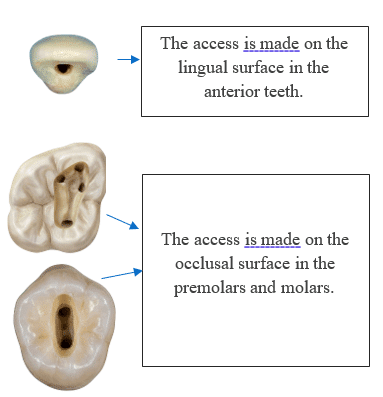
Anterior Teeth: Middle of the palatal side (preserve facial enamel).
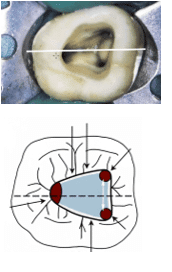
Premolars: Middle of the occlusal.
Molars: Central fossa, slightly to the mesial.
Advanced Clinical Tips
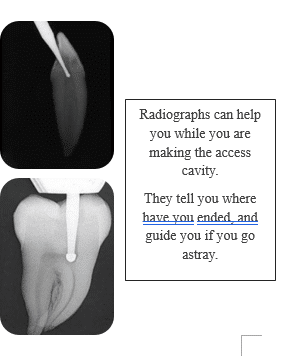
Take radiographs to guide preparation and verify position.
Protocol: Use a preoperative radiograph for anatomy and an immediate post-access radiograph to check depth and location relative to orifices.
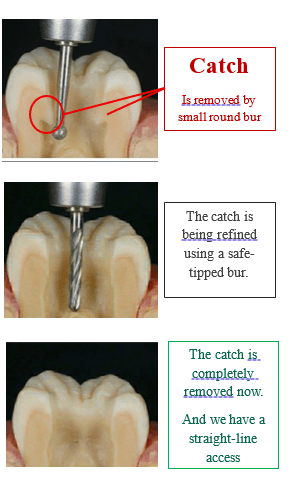
Definition: “Catches” are irregularities in walls where instruments get stuck.
Risk: Causes ledging or perforation.
Action: Use a round bur to smoothen internal walls (un-roofing the chamber). Verify smoothness with a fine endodontic explorer.
Further Principles
2. Minimal Removal of Tooth Structure
Remove as little structure as possible to preserve tooth integrity and strength. This supports the final restoration and ensures proper sealing.
3. Symmetry of Access
The cavity should follow the natural anatomy of the pulp chamber. Symmetry provides a predictable path for instruments and helps locate orifices efficiently.